

Getting into the garden
Part 3 of 3 in an exploration of neurodiversity, trauma, and systemic harm

Some people who put puzzles together like to put all of the pieces out on a table. I like to leave them in the box, where I can comb through them. I’ll choose a part of the image to focus on—the warm cozy den in the trunk of a tree surrounded by snow, the bricks on a house, a tablecloth—and then I’ll run my fingers through the box, looking for pieces that belong to the part I’m focusing on. I like gathering a small pile of possible pieces, and then piecing them together. Then, I’ll choose another part to focus on. Seek and join, seek and join, over and over and over again.
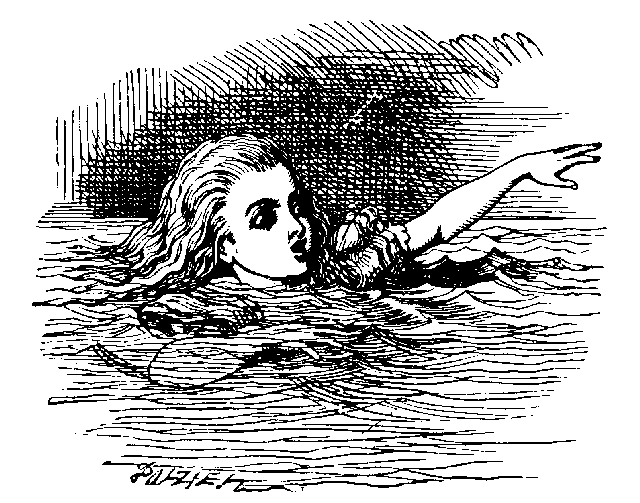
When Alice finally lands at the bottom of the rabbit hole, she finds herself in a long corridor of doors, all of them locked. On a table she finds a key, but it does not open any of the doors she can see. Finally, she finds a small door behind a curtain, and the key opens it. Through the door, Alice can see “the loveliest garden you ever saw.” Unfortunately, she is too big to get through the door. There follows a series of unsettling events, in which Alice drinks a potion that makes her small, then eats a cake that makes her large, then cools herself with a fan that makes her so small again she almost drowns in the tears she’s shed in frustration and disappointment at being unable to find a way into the garden.
For years, once I realized that I was an introvert with some autistic traits, I thought my choice to be an educator was a bad one. If I’d better understood myself, I’d say, I would not have chosen this career. I was good at many parts of teaching, and I often liked it, but try as I might (and I tried, a lot) I could not find a way to be OK in it. My favorite time of the day was early morning, before any students were in the building.
Still, I could never bring myself to leave it for something else. Before teaching, I’d worked a year-round job as an editor, and I couldn’t stand the idea of returning to that kind of tedium. I couldn’t stand the idea of spending every day at a desk and having only two weeks a year away from it.
Now that I know about the push-pull of AuDHD, I understand teaching’s appeal. It was both predictable (same kids, same schedule, same classes, every day) and not. Even though I often taught the same classes years in a row, I never taught them the same way twice. I had the freedom to change things up, satisfying what I now recognize as a need for novelty.
And of course, there was summer break. I needed it every year to recover from the months of teaching. I knew that no matter what I did to make money, I would need more than two weeks a year to recover from doing it.
I understand what it is like to grow small, then large, then small again. To keep trying to figure out how get everything to line up just right—size, key, door—so that you can finally get into a garden.
A friend asks: “Do you think a puzzle knows the places it has been sliced or just considers itself one big picture?” (You can see, I am sure, why we are friends.)
Her question makes me think about the kinds of puzzles that are more a compilation of images than one seamless one. Working a puzzle with a picture that is a collection of book covers, or tea tins, or houses, where each one is distinct, feels like putting together a collection of small puzzles. Even though I tend to break a puzzle image into parts, I don’t like these kinds of puzzles. I prefer to work toward one big, unified image.
I know this isn’t what my friend meant. She was talking about the way a whole picture is literally cut into parts. Each individual puzzle piece is a kind of picture, though, if you think about it. If you think about Cubism, maybe.
In John Tenniel’s illustrations for Alice in Wonderland, there is one image that reminds me a bit of the modern artists who would emerge in the wake of the Victorian era:
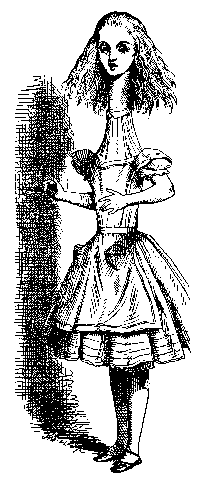
Alice is not cut into planes, the way Picasso might have drawn her, but there’s something about the distortion of her neck that speaks to the modernity on Carroll’s and Tenniel’s horizon. It’s the way her head remains small while the rest of her grows large. With such a neck, it would be relatively easy to cut that little head off.
One of the children I helped raise used to stay home from high school at least one day each week. They’d stay in bed and remain there while the rest of us went out into the world.
They infuriated me. Wouldn’t I like to stay home, too?
They puzzled me. Could they really not get up, or was it a choice?
They intrigued me. How were they making this work for them?
I grudgingly admired them. Everything I’d been taught from the time I was their age told me that their refusal was evidence of something wrong or weak, but I could see the strength it took to do what they were doing, a different kind of strength than the one I’d always used to get myself out of bed on the days when doing so felt nearly impossible.
(I am so tempted now to go off on a tangent that would include Victorian ideas about hysteria, Charlotte Perkins Gilman’s “The Yellow Wallpaper,” and trad wives and MAGA women—but I won’t. Nevertheless, I want you to know that these are pieces in the puzzle, too.)
When the pandemic came, it was terrible. And it was also wonderful, a truth I am loathe to admit out loud in the aftermath of such widespread suffering, even now, six years later. I turned a small bedroom into my work-from-home office. It has a south-facing window, so it got natural light most of the day. I had a comfortable chair. It was blessedly quiet. When I needed a break, I could walk down the hall and change a load of laundry, or put something in a marinade, or unload the dishwasher. I was more productive in my work than I had been in years, and at the end of the day, I had a kind of energy for living that I hadn’t had in a very long time. That first, disorienting spring I had time at the end of the day to sit on my front porch in waning afternoon sun and sip something cold before making dinner. The work was different and bad, and there was fear about so many things, AND I felt a kind of calm I’d never known in my adult life.
It is so often true that we cannot feel the weight of a load we are carrying until the weight is lifted. We cannot afford to let ourselves know how heavy it is, especially when we feel it is a load we cannot possibly put down. It wasn’t the weight of the pandemic that broke something in me; it was feeling the weight I’d been carrying before the pandemic hit that did it.
I’ve never had any interest in solving three-dimensional puzzles. How do you even do that? I like my puzzles to lie flat on a table. I like them to feel manageable.
But after my session with my therapist, when she says, yes neurodiversity, but also trauma but also toxic systems, I feel as if that’s what she’s given me—a box of puzzle pieces that I have to fit together into a structure that can stand up on its own. And there’s no picture on the box. (Wait, is there even a box?) I have to discover the picture as I put the puzzle together.
This is more novelty than I ever wanted.
The first time Alice shrinks and begins to cry, she sharply scolds herself.
“‘Come, there’s no use in crying like that!’ said Alice to herself, rather sharply; ‘I advise you to leave off this minute!’ She generally gave herself very good advice, (though she very seldom followed it), and sometimes she scolded herself so severely as to bring tears into her eyes; and once she remembered trying to box her own ears for having cheated herself in a game of croquet she was playing against herself, for this curious child was very fond of pretending to be two people. ‘But it’s no use now,” thought poor Alice, ‘to pretend to be two people! Why, there’s hardly enough of me left to make one respectable person!’”
Ah, Alice. I feel ya.
Alice drinks and eats and fans herself to find a way out of the rabbit hole and into the beautiful garden. I have been trying to read my way there.
In the weeks since I fell into the AuDHD rabbit hole, I have read and read and read. I have read about neurodivergence. I have read about trauma. I have read about patriarchy and capitalism and misogyny and feminism. I have read about attachment theory. I have read about intellectual giftedness (another tangent not addressed here, but also part of the puzzle).
The most important thing I have seen: It is hard to know where certain behaviors and patterns of behaviors come from. Behaviors that stem from trauma can look just like behaviors that stem from neurodivergence and can look just like behaviors that stem from attachment injuries. (Let’s not call them attachment disorders. The language we use matters.)
Let’s take hypervigilance, for example. What it has looked like for me:
My immediate response to anyone being late (even just a little bit) and unreachable is to imagine them in some kind of catastrophic situation. They’ve been in a car accident or assaulted or abducted. In my family we have jokingly called this my “dead in a ditch syndrome.” I know my response is illogical, and when I catch myself going there, I talk to myself much as Alice does. (CBT for the win!) But there is a tiny, tiny thrum of anxiety running through me until I know they are safe and not dead in a ditch (literally or metaphorically).
I often know my husband’s emotions before he does, especially if something is wrong for him. I’m attuned to his slightest indicators of distress: a jiggling foot, a flatness in his eyes, a particular way of breathing.
I am constantly clocking the behaviors and body language of other people in public settings, particularly those of men. Are they looking at something a bit too long? Is something off about their dress, is there something that doesn’t add up correctly? Are they looking at me—and if so, how and why?
Where does my hypervigilance come from? Is it the result of growing up in a family with a volatile parent, where I learned early that safety required reading the room for the most subtle indicators of pending danger? Or is it the result of a neurology that has difficulty filtering out necessary from unnecessary sensory information, so that my brain is paying attention to everything, all the time? Or is it from living in a female body in a society in which violence against women is so pervasive that attunement to threat was established before I was even conscious of it? Or is it from living in a society so dysfunctional that we cannot seem to stem our horrific and seemingly random acts of mass violence, and working in institutions where we regularly anticipated and prepared for such acts?
I suppose the answer is Yes. I suppose the answer is, All of the Above.
To make matters trickier, neurodivergent people are more likely to suffer from trauma than neurotypical people are. They are more likely to be diagnosed with a personality disorder, or anxiety, or depression. Of course they are! Bad things happen to us because we don’t get a lot of things about how other people work and operate! We don’t always behave in ways that others deem acceptable, especially authority-type others. Knowing that you’re likely to be doing things “wrong” a lot of the time would make anyone anxious and/or depressed. But also: Our society has created conceptions of behavioral disorders and mental illnesses that pathologize difference. My hypervigilance might very well be a logical response to the intersections between my biology, my history, and the environments I have lived within.
Borders and boundaries between our various paradigms for explaining human behavior and feelings feel slippery and shifty, and perhaps the most important truth is that we don’t really know enough about any of these things to have clear understandings of them. Our ideas about so many different things that fall under the umbrella of psychology have undergone such radical changes in the course of relatively recent history that it seems foolish to believe that today’s “knowledge” is definitive.
Where does that leave us? As reader Kari so eloquently responded to the second part of this series, “WELL WHAT THE FUCK DO I DO WITH ALL OF THIS, EXACTLY?”
Alice never does line everything up so that she has they key to the garden door in hand while she is the right size to go through it. After she cries a pool of tears and encounters a bunch of birds and animals in the water (whom she manages to offend by saying the wrong things about her cat, Dinah), she sets out to find the door but “everything seemed to have changed since her swim in the pool, and the great hall, with the glass table and the little door, had vanished completely.”
When I was teaching narrative writing to middle and high school students, I taught against one ending in particular: “And then the alarm went off, and she realized it was all a dream.”
It was a lazy ending, I said. It was unsatisfying, I said. It was an easy way out of the narrative dilemmas you’ve created, I said.
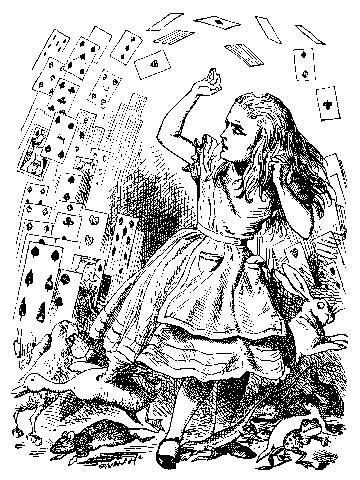
Imagine my disappointment with the ending of Alice’s Adventures in Wonderland, when the story turns out to have been a dream. At the climax—when the whole pack of royal cards comes flying down upon Alice in the Queen’s court—Alice wakes up with her head in her older sister’s lap, dead leaves from an overhead tree fluttering down on her face.
After telling her sister all about her dream, Alice runs into the house for tea. Her sister then goes into some kind of reverie, where she can feel the grass moving as the White Rabbit hustles by, and she can hear the rattling tea cups from the Mad Hatter’s party and the Queen’s shrill voice and the Mock Turtle’s sobs. But then she realizes that if she opens her eyes, all would revert to “dull reality.” Alice’s vivid world is something the sister consigns to an idealized, childlike way of being, and she imagines that when Alice is a grown woman she will “gather about her other little children, and make their eyes bright and eager with many a strange tale, perhaps even with the dream of Wonderland of long ago.” She imagines that adult Alice will “feel with all their simple sorrows, and find a pleasure in all their simple joys, remembering her own child-life, and the happy summer days.”
What a lazy, easy, and unsatisfying ending.
While working on these words, I wake up one morning with Jefferson Airplane’s “White Rabbit,” on repeat in my head. I have loved this song since I was a girl, especially the way it rises to its crescendo ending:
Remember what the dormouse said
Keep your head
Keep your head
I google the lyrics, wondering if there’s something more in them, something I need to see to bring this essay series to a satisfying ending (because I don’t have one). And that is how I learn that I have misheard the ending of this song for more than 50 years. It’s not “keep your head.” It’s “feed your head.”
How can I have not fully known something I’ve listened to (and loved) so many, many times? What other things do I not know that I think I know?
And how might our lives be different if we focused on feeding our heads rather than on trying to keep them, especially when we find ourselves in places like Wonderland, where what is said is not really how things are, and so many things don’t make the kind of sense we expect them to?
Don’t really make much sense at all, if we’re being honest.
How many times have some of us felt ruled by a Queen who wants to impose a sentence before a verdict has been reached, or a King who cannot decide whether what we don’t know is important or unimportant? How many times have we felt caught in a situation in which we are being held accountable to rules that are being made up on the spot, but we’re being told that they are the oldest rules in the book?
It’s never a dream we simply wake up from before skipping off to tea, is it?
Since we’re revising an understanding of a text, let’s reconsider the ending of Alice’s story.
Alice’s “dream” (nightmare?) ends when Alice, “having grown to her full size,” says to the Queen and her court, “‘You’re nothing but a pack of cards!’” It ends when Alice is neither a vulnerable, miniature version of herself nor a clumsy giant, but is her true size. It ends when she refuses the logic of Wonderland and starts speaking truth to a power who speaks nonsense. Alice, in a metaphorical sense, wakes up to and pushes back against the absurdity of Wonderland, which causes her return to consciousness in the “real” world.
Maybe the “waking up” to what Alice’s sister calls “dull reality” is a kind of going to sleep, a sleep that is necessary to be transformed into an adult who can function in the adult world. Maybe Alice’s sister is not a supporting character to the ending, a convenient resting place for Alice’s dreaming head, but is instead the one we are supposed to be paying attention to.
The ending turns in upon itself, as so many of the puzzles I’ve been trying to solve do.
The 3-Dness of the puzzle the therapist revealed puzzles me as much as the child who wouldn’t go to school once puzzled me. I have long believed that you cannot know how to respond to a difficulty if you don’t understand what is causing it. And there are neither clear causes nor clear answers to challenge of how to be OK in this world.
I’m also finding that the lack of sure answers frees me. I do not have to find the one right solution to the puzzle of living because there likely isn’t one. There is no picture on the box of the puzzle that is our existence. Who says that all the pieces even have to fit together? Isn’t it working the puzzle that is the point, rather than finishing it? (It always has been to me. Once the puzzle is done, I scoop up the pieces and put them back in the box for someone else to enjoy.)
The conclusions I’m reaching from my fall down the rabbit hole are these:
Living in this world is challenging, for all kinds of reasons. Each person has their own set. We can have multiple sources of challenge, and we can conceive of the challenges in multiple ways. The intersection of challenges can change or mask the nature of them, making them difficult to identify or understand.
Our responses to the world are neutral. They are not indicators of our character or our morality. Of strength or weakness. Of right or wrong. They just are. Regardless of what makes me a person who startles at sounds others barely register, I cannot control that response any more than I can control my height or the color of my hair.
Our biggest struggles come not from our differences, but from the world’s intolerance and misunderstanding of differences. They come from the way some people and systems use shame and a socially-acceptable rigidity to force some of us to deny what is true about ourselves. To justify not meeting our needs. To assert their hegemony over those who are not-them.
My answer to Kari’s “what the fuck do I do with all this?” question (for now, at least) is that the important thing is to feel the weight we carry and so often gaslight ourselves about. To see the absurdity and injustices and difficulties in the world and not try to put ourselves to sleep in order to tolerate them. To see and accept our own responses and their corresponding needs and do the best we can to craft a healthy existence that meets them, that allows us to carry both what we want to and what we must. And then feel OK about it.
Yes, and. That is the key that might get us through the garden door.
Keep your heads, friends. And feed them, too.
Whew, that was a long slog of a series! To be honest, I’m a little tired of Alice, puzzles, and this topic. (Of course I am!) I’m much more interested in what YOU have to say about any of this.
What does your metaphorical garden look and feel like? What do you do to make accommodations for yourself and feel OK in the world? Ever get song lyrics wrong in a major way? 🙂 Want to talk here about something only tangentially related? I’m here for any of it.
As always, when you click on the heart, it warms mine.
I’m so very interested in questions we do not have answers to. Complexity science is getting a foothold, but still, we can never unravel the forces that produce our bodies in any particular moment in time. This is part of what I am writing about, too. I do have a political answer to my question, but the truth will always be just outside of my grasp.
Yes, yes, and YES and...